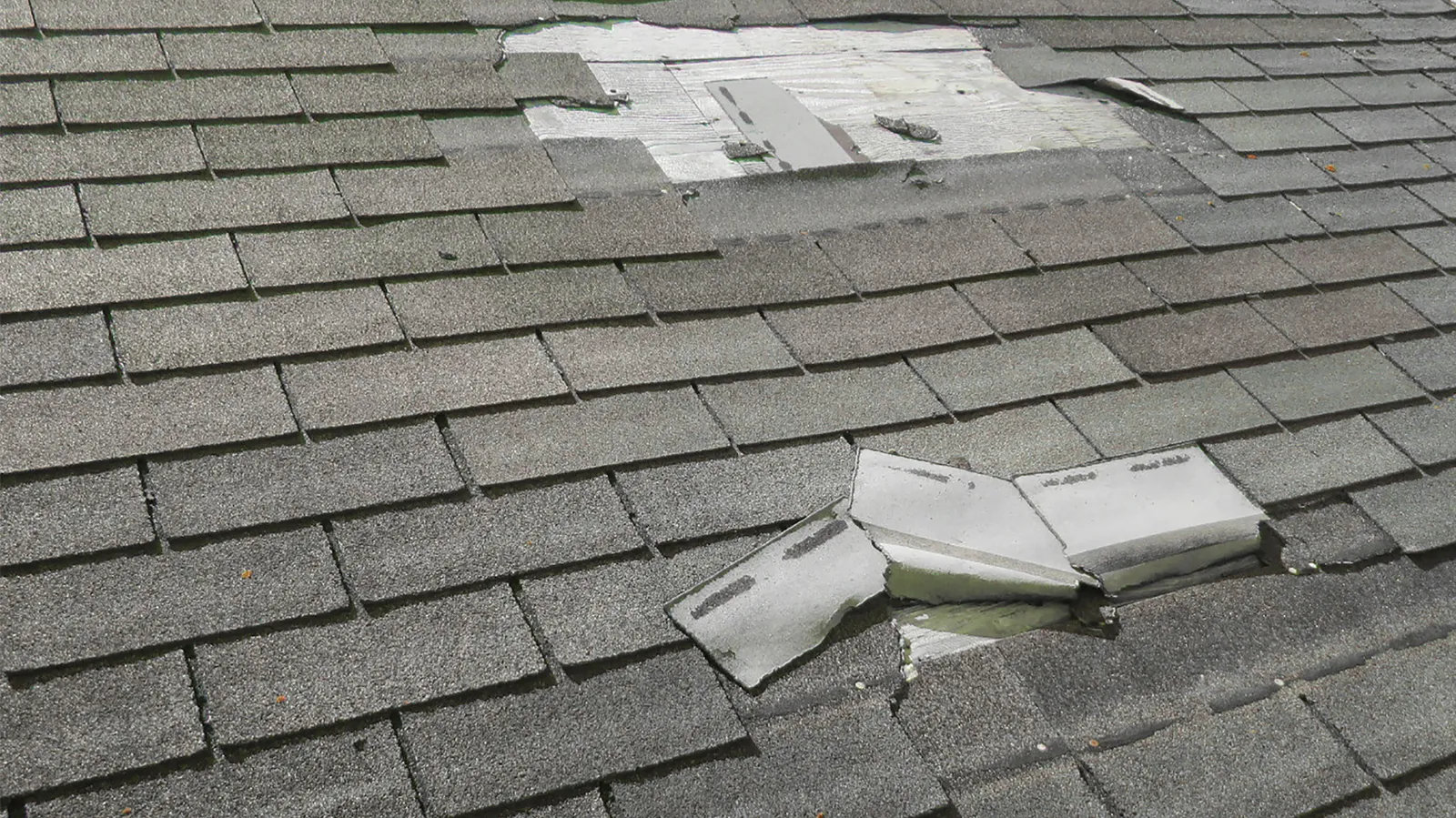
Hail damage in Melissa, TX is an awkward thing to be sure about. The storm is loud enough to wake the house, and by morning the roof looks the same as it did the day before, so you're left deciding whether to bother anybody about a roof that's showing you nothing. Here's the part that changes the decision. On an asphalt roof, hail does most of its work to a layer you can't see from the yard, which is why a roof can come through a storm looking fine and still have lost years off its life. You don't have to work that out from the driveway, and you don't have to be sure anything's wrong before you ask. That's what Melissa Roofing Co is here for, and our roofers are the ones who go up and settle it.
The damage happens under the granules
You went out and looked. That's more than most people do the morning after, and from where you were standing there was nothing to find. That's normal, and it's worth knowing why. A shingle is two things stacked. On top is the bed of granules, the part that takes the sun and the weather. Under it is the mat, which holds the shingle together and keeps water on the outside of your house.
Hail works through that in stages. First the granules come loose, which on its own is often cosmetic as long as the shingle stays covered. Then, when a stone lands hard enough, it drives granules down into the mat and fractures the material beneath them. That fracture is the damage. Nothing has to lift, tear, or come off the roof for a shingle to lose years. With larger stones or a brittle covering, the shingle cracks through and the whole thing becomes obvious, but that is the loud end of a range that mostly runs quiet.
So the yard is a poor place to judge from. At forty feet, a bruised shingle and a healthy one are the same color and the same shape. The difference shows up under a hand: a bruise gives when you press it, soft and spongy the way fruit is, and the granules around it have thinned into a circle. You were never going to see that from your driveway, and nobody expects you to.
A young Melissa roof hides it better
Most of the houses here are on their first covering. The town went up fast and it went up recently, and if your street looks like the rest of Melissa, the roof over your head went on somewhere around 2013. That works against you after a storm, because a young roof gives you nothing to compare against. There's no curling at the edges, no bald patch that's been there for years, nothing that stands out as a warning.
So hail lands on a roof with no history. You have no reason to think anything is wrong, and there's usually nothing you could have seen even if you had gone looking. What changes is how much life the roof has left in it, and that is a question a roofer has to answer from the roof.
It cuts the other way too, and that part is worth hearing. Stones around an inch across, roughly a quarter, are about where damage to asphalt commonly starts, and plenty of what falls on this town is smaller than that. Size is not the whole story either: a smaller stone driven by a sixty mile an hour gust carries more energy than a bigger one falling through still air, which is why two houses on the same street can come out of one storm differently. How often the sky here does this is on the county hail record, and it makes for sobering reading.
What our roofers look for after hail
One mark on one shingle settles very little. What tells the story is a pattern: bruising that gathers on the slopes that faced the storm, granules piled where the downspouts empty, soft spots that give under a thumb. One of our roofers walks the whole roof looking for that, slope by slope, because hail almost never treats all four sides of a house the same.
The metal is often what decides it. Vents, flashing and gutter aprons dent where shingles show nothing at all, and a vent cap with fresh dimples says stones of a certain size reached that plane of the roof. If a stone was big enough to mark soft aluminum, the shingles beside it took the same hit. That is one address being read on its own terms, and it is the thing no county-wide number can do for you.
There's a fair amount you can find yourself, and none of it involves a ladder. Coarse black grit collecting where a downspout drains is the roof's armor washing off. Dented gutters, a dinged mailbox, pocked window screens, spatter marks on the grill or the patio table, and mashed fins on the outdoor air conditioning unit all say something about what size stone came down on your address. Write down what you find, or take a picture of it. It gives our roofers a head start, and it costs you a slow walk around your own house. If the list starts adding up, that's the point to ask for a roof inspection.
Why waiting makes hail harder to find
Wait and see is a reasonable instinct, and it costs more here than it does with most roof problems. Hail evidence fades. Granules keep washing off, dents weather and dull, and a bruise that was unmistakable one spring settles into something that just looks like ordinary aging by the next one. The damage is still there. It only gets harder to tell hail apart from age.
There's a second clock running too. Policies carry their own windows for reporting storm damage, and those windows are measured from the storm itself. Both clocks run whether or not anybody has been on your roof. If a claim turns out to be part of this, what insurance does with a hailed roof runs on rules of its own, and it is easier to deal with while the roof can still show what happened.
None of that means you have to hurry. It means the answer is easier to get now than it will be later, and that you get to decide what to do with it on your own clock.
Where a hailed roof goes from here
Three things can be true when somebody comes down off your roof, and two of them are good news. The hail did nothing worth acting on. Or the damage is confined to the slopes that caught the storm, and a repair puts it right. Or the mat is fractured widely enough that patching it would buy you a season and no more.
Which one you are in is decided by what is on the mat, and that is why this keeps coming back to somebody going up and looking. If it lands on the repair side, storm and hail damage repair covers what that work involves. If it lands on the replacement side, the covering you pick next matters more than most people expect, and the shingle guide is where the impact-rated options are laid out.
Whichever one it turns out to be, you hear it in words you can act on, and nothing moves until you say so.
If hail came over your street and nobody has been on your roof since, send Melissa Roofing Co the address and whatever you noticed from the ground. One of our roofers goes up, looks at every slope, and tells you what is on the mat. You'll know where your roof stands, and what you do about it is yours.
Have our roofers take a look